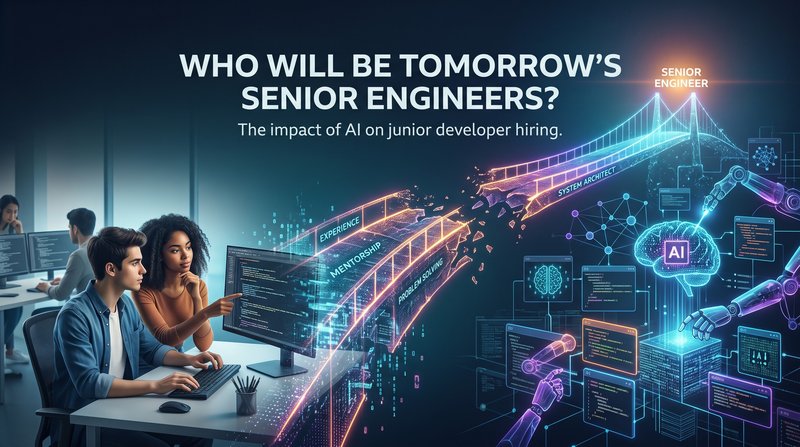
The headline that went around
Anthropic will stop hiring junior developers by mid-2027.
What the document says
On October 16 four Anthropic economists published a report on how work is changing inside the company that makes Claude. They use company data (hiring, headcount, agent use, productivity), three employee surveys and seventeen interviews.
The sentence that started it all is in the introduction: even as the company grows, relative hiring in junior technical positions has slowed. The numbers: since early 2025 the junior share of headcount in technical departments went from 21 to 14 percent, and the junior share of new technical hires from 27 to 9 percent. Junior job postings have fallen especially since December 2025.
Over the same period the way people work changed. Within six months, code commits per engineer grew about fivefold. By August, in sessions directed by employees, agents worked six hours for every hour of the person overseeing them. And hiring managers now look more at candidates' autonomy and judgment, less at specific technical expertise.
The chart going around takes the monthly data and draws a straight line through it: junior hires reach zero around June 2027, junior headcount around July 2028. That projection is not in the report. It is an extrapolation someone else made from Anthropic's data, and who made it is not stated.
What we don't know
Whether the straight line holds. Fifteen months of data from one company growing very fast cannot tell where the curve will go. An extended line is a hypothesis, not a forecast.
How much is really down to agents. The authors warn that early adopters of the tools are not random, and that part of the shift may come from non-technical functions growing. No one outside the company has checked the data.
Whether Anthropic is an example. The authors themselves write that many of its practices cannot be replicated across the economy.
Morgan's take
If we stop hiring junior developers, who will become tomorrow's senior engineers?
Experience doesn't appear out of nowhere. It's built by solving problems, making mistakes, maintaining legacy systems, learning to read complex architectures. If we automate the very work people learn from, who will train the next generation?
Perhaps in ten or twenty years we will still need senior engineers, with different skills and responsibilities. Or perhaps agents will design, build and verify complex systems with little human supervision. We can't take either outcome for granted: neither the disappearance of the work, nor the survival of today's professions as they are.
Then there is a third question. The most capable models are closed: they are like a hotel room. You can work in it, organize your business inside it, build your software around it. But the room isn't yours. What happens if, just as software, skills and companies have come to depend on it, the owner changes the terms, raises prices or cuts off access? Open models have the opposite problem: once they're released, controlling how they're used is hard.
Perhaps the real question isn't how many jobs will be automated, but whether we are building skills, businesses and infrastructure we will still be able to control once artificial intelligence has become indispensable.
The chapter in the book
In the chapter, a project's maintainers deliberately leave an easy change to newcomers, so they can learn to contribute. An agent takes it. It is the same question on a small scale: who learns, if a machine climbs the first step?